Posts

Training Goat Producers in Guatemala to Ensure They Are Sustainable and Competitive
Image
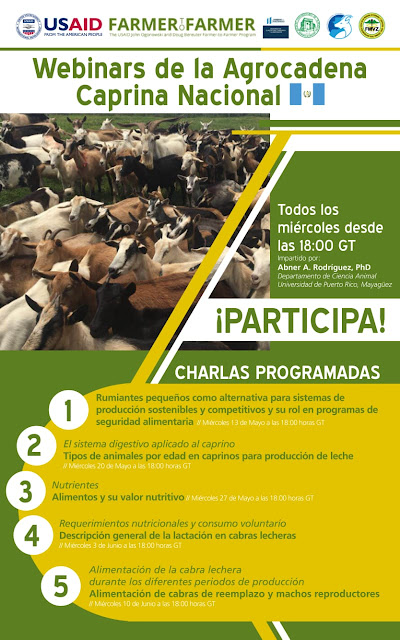
The COVID-19 pandemic changed agricultural activities in the whole world and Guatemalan farmers were no exception. Most of them do not have access to technical assistance and training during normal conditions, and this was worsened due to the pandemic, as no national or international technicians or trainers could physically reach rural communities and farms. The Farmer-to-Farmer (F2F) program in Guatemala implemented a rapid response to this complication. They contacted their partners and host organizations and asked them about their training and assistance needs that could be fulfilled virtually. The F2F team wanted to make sure that they could continue supporting and assisting their hosts remotely, and in this way reduce the impact of the pandemic on their small businesses so that they could continue working to generate employment and provide income in their rural communities. The F2F program started to implement virtual assignments in May 2020, supporting agribusiness value chains, ...

Conserving Soil Quality with Banana Producers in the Dominican Republic

Image
In the Dominican Republic, changes in rainfall patterns result in soil erosion and lost harvests, affecting rural agricultural families. To help ameliorate this problem, a F2F volunteer was requested to train smallholder banana producers in the northwest of the country in two major areas: the restoration of depleted soils through the addition of organic matter, and the strengthening of farming plots against extreme weather events that can cause erosion of fertile soils. The host for this assignment was Bananos Ecológicos de la Línea Noroeste (BANELINO), an association that seeks to improve the living conditions of small producers, workers, their families, and the community by providing technical assistance to its associates. Currently, BANELINO is comprised of more than 330 producers. It is an established and well-managed organization, with strong leadership, knowledgeable and dedicated field technicians, and supportive and involved members. Dr. Hwei Yiing Johnson was chosen to fulfill...

Better Marketing and Communications to Showcase the Work of our Hosts in Colombia

Image
Salva Terra Foundation has focused on supporting vulnerable communities through sustainable agriculture. They work with impoverished populations and victims of violence in Medellin and aim to promote farming and develop local skills to work in the agricultural industry in an ecological manner. This process of bringing together concepts such as social impact, sustainable development, environmental protection, and food security requires excellent outreach and promotion. Therefore, they requested a F2F volunteer to help them develop a communication and marketing plan. The chosen volunteer for this assignment was Dr. Sindy Chapa. She has a B.A. in Mass Media Communications, with a Minor in Television and Art Design, an MBA, and Ph.D. in International Business/Marketing. She is the Director and Associate Professor at the Center for Hispanic Marketing Communication at Florida State University and has won several communications awards. Dr. Chapa decided to use Salva Terra as one of the case ...

Post-Harvest Training for Vegetable Producers in Guyana

Image
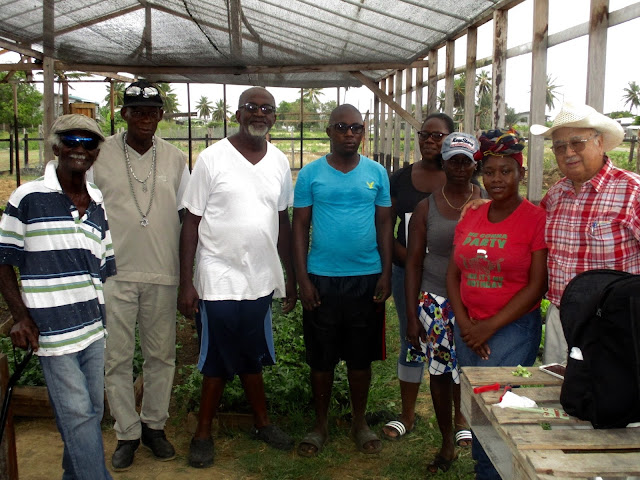
  Mr. Mauricio Rodriguez traveIed to Guyana for two weeks between April and May 2019 to train farmers in postharvest handling, the use of the cold chain, and packinghouse design for each host facility. Mr. Rodriguez holds a Master of Science in horticulture from the University of California, Davis and he most recently worked as a technical coordinator for the Global Cold Chain Alliance. During the assignment, Mr. Rodriguez visited seed nurseries, shade-house growers using elevated tables, vegetable producers using large boxes, and herb producers using hydroponics systems. He also visited supermarkets selling fresh products from the program growers. He trained the beneficiaries in how to mitigate the effects of high temperatures on produce using different low-cost alternatives for precooling. The volunteer made specific recommendations to each producer visited, for example how to precool the product before packing it to avoid water condensation on the inside of the container that ca...

Apoyando a productores de melocotón a través de ANAPDE en Guatemala

Image
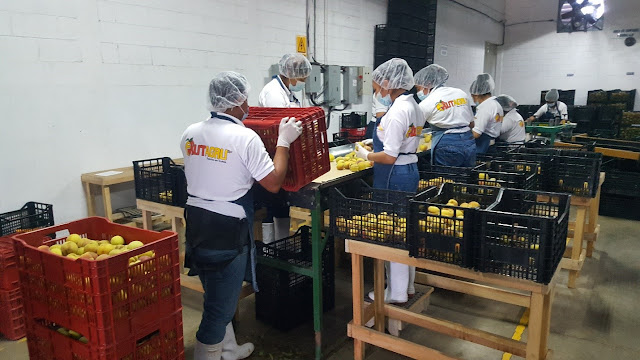
Una de las organizaciones anfitrionas con las que trabaja el programa Farmer-to-Farmer en Guatemala, es la Asociación Nacional de Productores de Frutales Deciduos (ANAPDE), la cual integra a fruticultores de las altiplanicies del país. Está constituida legalmente como una entidad sin ánimo de lucro, dedicada a promover el desarrollo económico, social y tecnológico del sector frutícola y especialmente de productores de frutos deciduos en Guatemala. En febrero de 2016, el voluntario de Farmer-to-Farmer Gavin D. Vanderpool le brindó asistencia técnica a ANAPDE para mitigar y controlar heladas y granizo en las áreas de producción. Gavin realizó visitas de campo a 34 huertos diferentes, habló con el personal y los agricultores y revisó los diferentes métodos y técnicas que podían ser implementadas. Durante su asignación, más de 50 agricultores y personal técnico fueron capacitados en el uso de métodos activos como ventiladores, drenajes de aire frío, aplicaciones de calor, riego por aspersi...

Identifying and Controlling Avocado Pests in Myanmar

Image
In Myanmar, the expanding avocado industry needed support to strengthen its capacity to identify, control, and manage common pests that harm crop yields. Therefore, the Myanmar Avocado Producer and Exporter Association (MAVO) requested a F2F volunteer to provide its members with guidance on pest mitigation with an emphasis on alternatives to pesticides. MAVO’s aim is to provide its associates with a selection of avocado varieties, and technical support in topics such as nursery production, pest and disease identification, post-harvest technology and market information. Since most of its members are young, they are very active and have been organizing the Avocado Festival and Competition since 2017.  The recruited volunteer for this assignment was Dr. Jorge Peña, who has a BS in Agronomy, an MS in Entomology, a PhD in Entomology and is an Emeritus Professor at the University of Florida. He has worked in the past to determine the biology and seasonality of avocado loopers and biologi...

Developing a Mushroom Production Curriculum in Jamaica

Image
In July 2020, after the onset of the COVID-19 virus, the Jamaica Farmer-to-Farmer program finished its second remote assignment, hosted by the Ebony Park Heart Academy. The academy was launched in 1987 and is located in Toll Gate, Clarendon, Jamaica. The objective of the institution is to provide training in agricultural business development and production. It is the top Human Employment and Resource Training Trust/National Training Agency (HEART Trust/NTA) institution in the island for training and certification in agriculture and occupies some 500 acres of land. It has numerous programs and 500 places annually, which are being offered with free boarding and no tuition cost; enrolled students are only required to pay the cost for registration and uniforms. The chosen volunteer for this assignment was Dr. Khaled Hameed, a specialist in mushroom production. He holds a Ph.D. in Plant Pathology, Physiology, and Mycology and has over 20 years of experience as a Professor.  In Septem...

Increasing Strawberry Production in the Dominican Republic

Image
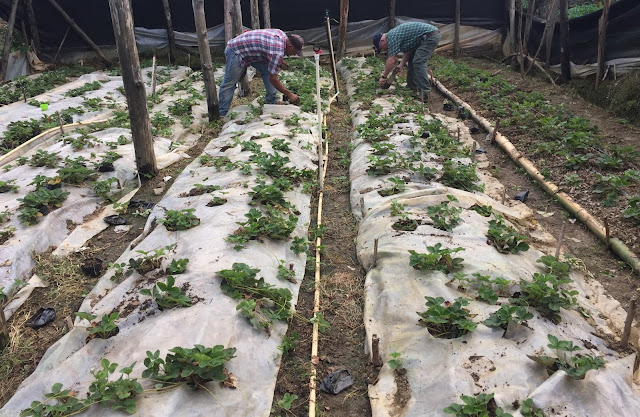
The Sabaneta Women’s Group is an association founded in 2013 by the community of Sabaneta, in San José de las Matas, Dominican Republic. It is currently composed of 10 members, who usually meet once a month to discuss key points, work on sustainable communal projects and reforestation, and organize interesting lectures. They also have a small savings group that includes children, youth and men. Since the beginning, they have grown and developed several coffee products and in 2019 decided to start a project focused on strawberry and vegetable production to diversify plantation areas. They allocated approximately 1,000 square meters of land in a greenhouse to strawberry production.  Strawberry cultivation is very dynamic that has many variables. Quality fruits can be grown in a period of eight months, between 800 and 1,300 meters above sea level, with optimal conditions taking place between October and May. In mid-2019, the Sabaneta Women’s Group requested a Farmer-to-Farmer voluntee...

Evaluating the Funding Sources of Coffee Exporters in Colombia

Image
Campesino Specialty Coffee is a Colombian company sourcing specialty coffee directly from smallholder farmers in Antioquia. To fulfill their mission of providing long-term solutions to coffee communities, they have a direct relationship with producers, providing complete transparency and upholding sustainability at the farm level. They started in 2016 in the town of Jericó, Antioquia with five dedicated farmers and have grown to over 120 producers. By focusing on quality, they have been able to increase the return to their producer partners and provide a higher-quality coffee to their roaster partners, creating a sustainable business operation for all parties involved. To further increase the impact in the community, they have launched a Coffee Education Center in Jericó, to provide continuing coffee education to their producer partners, their families, and the coffee community  To improve their financial situation, they requested a local and a remote F2F volunteer to evaluate t...

Honeybee Disease Management and Apiary Inspection in Guyana

Image
The demand for honey in Guyana has rapidly increased as people seek healthier sweetener options, causing a shortage of beekeepers in the country relative to market demand. To accelerate the entry into beekeeping for aspiring Guyanese farmers, a F2F volunteer was requested by the Guyana Livestock Development Agency (GLDA) to help them train its personnel in disease management and apiary inspection.  The GLDA is the single institution mandated by the Government of Guyana to implement and coordinate the implementation of livestock development activities. It aims to promote greater efficiency in the livestock product industry and the control of animal movement into and within Guyana to prevent the introduction and spread of animal diseases.  Dr. Michael Goblirsch was the volunteer selected for this assignment. Dr. Goblirsch holds a Ph.D. in Entomology from the University of Minnesota where he oversees the Technical Laboratory of the Bee Research Facility and teaches various subjec...