Posts

A Look Back: Haiti Horticulture
Image
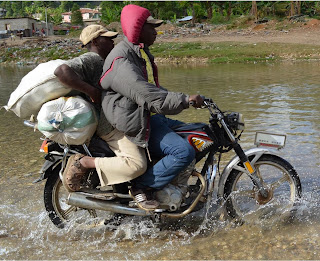
Farmers bringing their products to market Farmer-to-Farmer’s horticulture projects in Haiti have sought to improve production yields and profitability for small- and medium-scale fruit and vegetable producers. Improved production has been achieved through fundamental activities like conservation, fertility, and pest management. Building on these accomplishments, farmers have then been able improve post-harvest handling, processing, packaging and labeling, and market linkages. Some challenges still remain, including transportation, but farmers are seeing impacts from the technical assistance they received. From 2008 to 2013, 29 horticulture volunteers engaged in assignments ranging from permaculture training and seedling management to pest control and small-scale organic farming. The program has seen some excellent results. For example, the formation of the Lory Producers Association, located in the small farming community of Lory in northern Haiti, was a result of F2F and Ma...
Composting to Benefit Farmers and the Environment in Guyana

Image
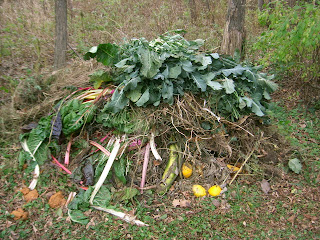
Compost – decomposed organic material that is recycled as a soil supplement or fertilizer – is increasingly used in organic gardening and agriculture because of its economic and environmental benefits. Compost is created by combining organic wastes such as food scraps, yard trimmings and manure in proper ratios into piles or vessels and adding additional “ingredients” to facilitate the breakdown of the mixture. By manipulating the pile to produce high temperatures, pathogens and weed seeds are destroyed, and the mixture stabilizes to form mature compost; at this point, it can be added to soil to boost nutrient content and fuel plant growth. The benefits of creating compost, or “composting”, include: low cost; improves moisture and nutrient content of soil, promoting increased crop yield; replaces chemical fertilizers; diverts household/industrial wastes from the garbage can and, eventually, landfills. In Guyana,South America, individual vegetable producers, farms, agricultur...

Happy World Food Day!

Image
In Latin America and the Caribbean, although the average standard of living has increased in recent decades, income inequality remains widespread. Impoverished people, particularly in rural areas, still face many barriers to achieving food security, which is defined as having access to sufficient, safe, and nutritious food to maintain a healthy and active life. Food insecurity is particularly a concern for low-income countries where Partners works, such as Haiti and Nicaragua, which are ranked as the poorest and second poorest, respectively, in the Western Hemisphere. In Nicaragua, many families subsist on just a few dollars a day and consume disproportionate amounts of corn, beans, and rice, rather than fruits, vegetables, and other nutritious foods. Seeds are unaffordable or inaccessible due to transportation barriers and adequate knowledge, funds, and resources for seasonal fruit and vegetable preservation are limited. Many rural and food insecure families do not own canni...

Got Milk? Nicaragua’s Dairy Producers show Substantial Improvements as a Result of F2F Program

Image
As the current Farmer to Farmer (F2F) program cycle comes to a close, F2F staff are taking a look back at the impacts volunteer visits have had on agriculture and food security in Latin America and the Caribbean over the past five years.   In Nicaragua, volunteer expertise has been concentrated in dairy and horticulture – two agricultural industries that make up a large portion of the country’s economy.   Two farmers from the dairy-producing region of Camoapa, Boaco who have worked with several F2F volunteers over the course of the program and, as a result, have shown impressive improvements in production and nutrition on their farms are Josefa Miranda and Edmundo Robleto. Josefa Miranda is a female dairy farmer who has been working with F2F since January of 2010.   Two of her main objectives when beginning her collaboration with F2F were to improve fodder used as livestock feed and increase milk production on her farm.   Several F2F volunteers worked one-on-one w...

F2F Focus on “Tecnicos” in the Dominican Republic Key to Improvements in Farm & Greenhouse Management

Image
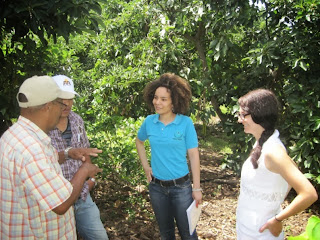
Claire (far right) with F2F field officer Mabel Barinas and producers Producers affiliated with the Farmer-to-Farmer (F2F) program in the Dominican Republic (DR) have shown impressive improvements in the past five years, according to a recent trip report by Claire Clugston, an experienced development practitioner in the DR.   Claire has been affiliated with the F2F program for over a year, initially as a graduate intern in the Washington, D.C. office and later as a volunteer with the University of Wisconsin helping with monitoring and evaluation efforts in the DR – the same country where she served as a Peace Corps Volunteer (PCV) for three and a half years.   Because of Claire’s Spanish language skills and familiarity with development work in the DR, she was able to get a true grasp on how F2F’s approach there has contributed towards sustainable agricultural development. During Claire’s volunteer visit this past August, she made several important observations regardin...

Small Business Development: Haiti

Image
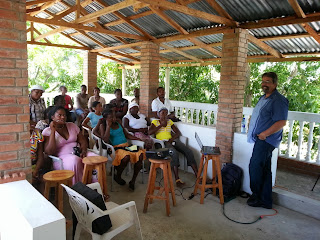
Jim Crandall training new entrepreneurs. Small business development is a multi-dimensional and fluid process. In Haiti, programs like F2F and Makouti Agro-Enterprise support farmers in establishing a production system – an essential component to starting a business. By providing person-to-person, hands-on training, F2F and Makouti contribute to increasing producers’ chances of success. In addition to a healthy, efficient production system, a business needs a business plan to guide decisions about facilities, production, and marketing, with an eye towards profitability and long-term sustainability. This past June, F2F volunteer Jim Crandall applied his experience in cooperative business development to assist producer networks in Haiti. His focus was on enabling producers to make business decisions based on the network as a whole, not just on individuals. Jim spent his first week in the Port-au-Prince area working specifically with two rabbit producer associations. He led sessi...

F2F Teams up with Colombia's SENA to Boost Fruit Industry in Department of Huila

Image
F2F volunteer Dr. Robert Paull of the University of Hawaii at Manoa Huila, 1 of Colombia’s 32 departments, is recognized nationally for its tropical fruit industry. Located in the country’s southwest region, Huila boasts 25 tropical fruit species spanning 10,699 hectares (26,438 acres), and is Colombia’s number 1 producer of passion fruit and pineapple. That said, Huila’s fruit industry is currently performing below the national average, considered to be the result of a lack of direct assistance and improved technologies at the producer level. To address this issue, Colombia’s National Learning Service (SENA) has linked up with Farmer to Farmer to facilitate collaboration among U.S. tropical fruit specialist, Dr. Robert Paull, SENA instructors, and Huila’s fruit producers. Dr. Paull, Chairman of the Department of Tropical Plant & Soil Science at the  University of Hawaii at Manoa, has been in Huila since September 8th to learn about tropical fruit produ...

Colombia’s Amazon World Ecological Park: Marketing Aromatic Teas One Year After F2F Volunteer Visit

Image
In November of last year, Farmer-to-Farmer Volunteer Matthias Resien had taken a trip to Leticia, Colombia to provide training to staff at the Amazon World Ecological Park regarding dehydration techniques for making teas, packaging them, and developing marketing strategies. The park, which opened in 2011 and is known for its sustainable use of biodiversity, has many different species of aromatic plants that have large potential in the tea market, particularly for tourists visiting the park. Matthias’s visit was essential in getting the business started by helping to build a drying structure at the park and showing how to blend different herbs for aromatic teas that will be sold. Today, almost one year later, park staff are now selling tea to visitors and are in the process of expanding their market even more. They continue to make improvements to the drying house to adapt to local environmental conditions and create a stronger structure. In the future, they are looking into desi...

F2F Small Animal Volunteer Myriam Kaplan-Pasternak Makes 15th Visit to Haiti

Image
Rabbits are a good source of nutrition and income for smallholder Haitian farmers Long-time Farmer-to-Farmer (F2F) Volunteer Myriam Kaplan-Pasternak recently returned from her fifteenth trip to Haiti in seven years. As a Doctor of Veterinary Medicine from California, Myriam has had a unique volunteer experience in that she’s been able to follow the progression of the rabbit industry in Haiti, with rabbit meat becoming increasingly accepted on a larger scale as a viable source of nutrition and income for smallholder farmers. When Myriam first started volunteering with F2F in Haiti in 2006, there were fewer than 100 rabbit producers in the country, and only one of them was also eating the rabbits she raised. Today, with the help of F2F and Makouti Agro-Enterprise, this number has grown to over 1,000 producers with almost all raising rabbits for both personal consumption and sale. Boiling and mixing cassava to include in rabbit feed blocks Myriam’s most recent visit to Hait...

Professor of Forestry, Charles Ruffner, Promotes Agroforestry in the Dominican Republic

Image
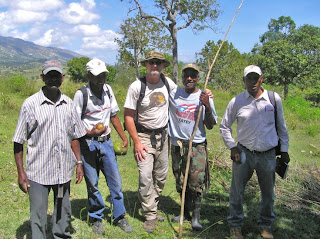
 Farmer to Farmer volunteer Charles Ruffner with Dominican producers Last month, the community of El Cercado, San Juan in the Dominican Republic received a visit from Charles Ruffner, a Forestry Professor at Southern Illinois University. During his visit, Charles worked with the San Pedro and Pablo Federation, a nongovernmental organization of 21 farmer associations and 600 subsistence farm families that helps producers implement agroforestry practices on their farms. Agroforestry is a farming technique that involves planting fruit, nut, and woody trees on the farm with a variety of crops. Charles’s role during his week-long visit was to help farmers map and plan these planting schemes so they could not only lessen the environmental impacts of their farming practices but also improve their incomes.  Smoke in the mountains - a result of slash-and-burn agricultural techniques Agroforestry is being promoted as a farmer-friendly way to reduce the negative impacts of...