Posts

Storytelling Strategies for Agricultural & Economic Development in Guatemala
Image
Volunteering with USAID-funded Farmer-to-Farmer Program in San Pedro Las Huertas By Laurie Posner, F2F Volunteer in February 2023 A sapphire sky ringed by hulking volcanoes. Sun yellow, brick red and ochre facades giving way to cobblestone streets, then dusty roadways and forested hillsides. These, the impressions that arise as we head toward the outskirts of Antigua to Yogi Super Foods’ factory in San Pedro Las Huertas. In late January, Guatemala’s Central Highlands region is pretty much the polar opposite of my home in Southeast Michigan. Emphasis on polar. Rooftop solar panels installed at Yogi Super Foods’ factory in San Pedro Las Huertas. Photo: Laurie Posner When we reach the small factory, it’s bustling with construction — and creativity. This past year, YSF founder and CEO Marco Barbi and his team have installed rooftop solar panels to make good on the company’s promise of greater energy efficiency and sustainability. Meanwhile, production manager Hector Jolón tests new equipme...
World Water Day: Community Water Conservation and Education in the Wayuu Indigenous Community

Image
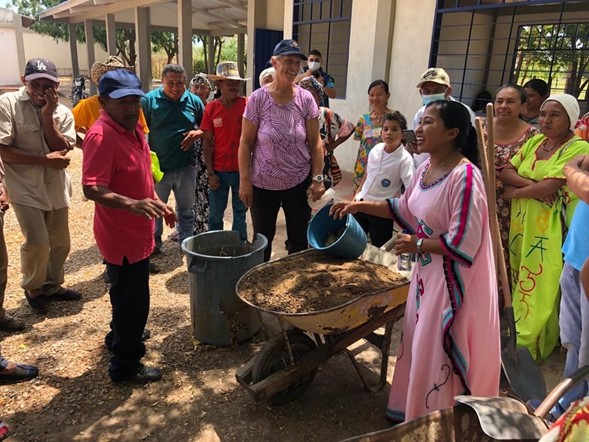
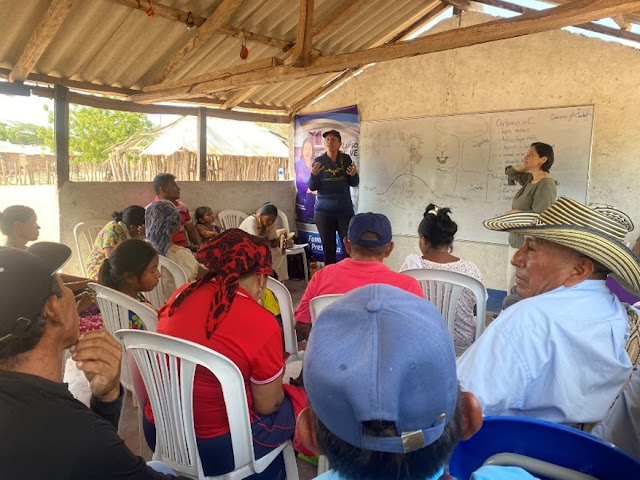
I previously volunteered with Farmer-to-Farmer in the Dominican Republic, but this was my first assignment in Colombia. When I was contacted for a water quality focused assignment in northern Colombia, I was thrilled to accept the assignment. My assignment was to train schoolteachers and other members of the Wayuu indigenous community in water desalinization, water purification techniques, and other agricultural activities.  After an initial meeting with the local sponsoring organization, Fundación Maria Luisa , and teachers at the school, I was given a tour of typical vegetable, fruit, and livestock production. I was also shown sources of water which include shallow hand-dug wells, a few windmill or solar-powered community wells, and a nearby river. Access to clean and adequate quantities of water is always a struggle, particularly for rancherias further away from wells. During dry months, water is scarce and often has trace salts and other contamination issues. The community was ...

Interactive and Accessible Watershed Conservation Education through Scale Models

Image
Pictured above from left to right: F2F Field Officers Franqui Linarez and Maria Montas, F2F Volunteers Patricia Algara and Cesar Cahusac  Last year, Patricia Algara was invited to the Dominican Republic to consult with APEDI and Fondo Agua Yaque del Norte through Partners of the Americas’ USAID-funded Farmer-to-Farmer Program. In their effort to promote education and conservation of the Yaque del Norte River's natural resources they want to build a interactive scale model of the entire watershed at the Parque Central in Santiago so that people can better understand the importance and magnitude of the river and the impacts that urban and agricultural pollution is having on its waters.  The Yaque del Norte River Basin is the most important one in the Dominican Republic, with an extension of 7.053 km², equivalent to a 14.6% of the national territory. It impacts around 1.8 million people in 40 different municipalities from six different provinces. It has a length of 296 kilomete...

A Packed two weeks of Agro-Processing in Guyana!

Image
By: Carolyn Kreuzkamp It has now been four days since I left my F2F assignment in Guyana. The emotions I feel are mixed: sadness from leaving the country right when I was becoming familiar with its rhythms, people, and food; joy for having been kindly welcomed into the homes and workplaces of total strangers; exhaustion from working day & night to complete a years’ worth of work and research in two weeks; and hope for the opportunity to return and build upon the strong foundation of both personal and professional relationships I invested in while on my first F2F assignment. Within two weeks of finding out about the F2F Guyana opportunity, I was screened, onboarded, and delivered to Georgetown with an open mind. I was excited to work with Ashdel Enterprise, a women-led agro-processing company, as a business plan and marketing specialist. I jumped right in when I arrived. Grace Parris, the owner of Ashdel Enterprise and I made a list of needs much more thorough and nuanced than the ...

International Women's Day: Women in F2F!

Image
Happy International Women’s Day! Did you know that women make up 43% of global agricultural labor force? The Farmer-to-Farmer program at Partners of the Americas is proud to work with talented women throughout the Americas, from our US-based volunteer experts to the communities of women agricultural producers and leaders.  Since 2019, we have hosted over 180 women volunteers in the six countries that we work in. Meet some of our women volunteers and women-led hosts below! Maria Luisa's Foundation, Colombia Jan Surface traveled to La Guajira, Colombia to support the Wayuu indigenous community at their school, Pulitchamana . She conducted trainings in water management, conservation, and basic desalination and filtering techniques, improving the quality of water to which children and the entire community have access. Institute of the Environment, The Dominican Republic Kristina Howlett worked with students at the Institute of the Environment as an ESL Specialist. She created dida...

Innovating Food Production with Drip Irrigation in Guyanese Prisons

Image
 By: F2F Guyana Volunteer, John Tiedeman - Redding, CA My assignment with the F2F Guyana program was from Jan 15 - 29, 2023. The focus was to introduce drip irrigation on prison farms to increase food production for people experiencing incarceration. An additional goal was to provide training to prison staff and the people who were incarcerated. The conditions for drip irrigation on orchard and vegetable crops at Timehri prison were well-suited for drip:   sandy soils and limited water supply. Due to lack of regular irrigation, crops in full sun were stunted or dead. Hand watering and portable lawn sprinklers make it difficult to maintain consistent, uniform irrigation required on sandy soils (low water holding capacity). We set up a small gravity-fed drip system to demonstrate the uniform application possible with drip irrigation. Other methods attempted (flooding, small holes drilled in pvc pipe) have proven unsuccessful. Our next step was to measure both pre...

Five Marketing Lessons from Working with Cacao Producers in Colombia

Image
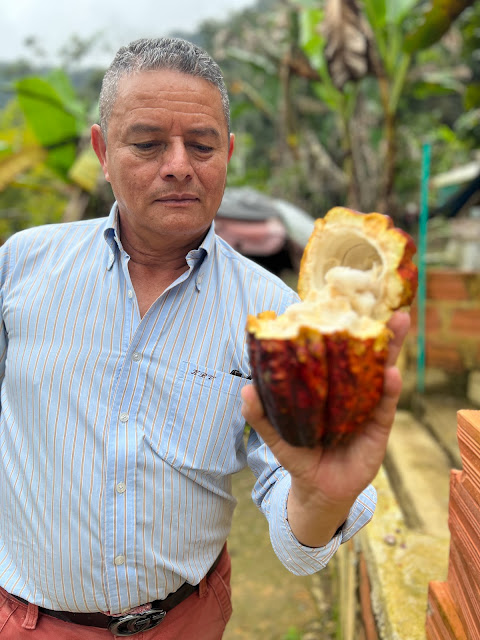
  By Tasha Prados After fifty years of violence, many farmers in Colombia were trapped growing illicit crops—the coca used to make cocaine. In 2014, one farmer in Otanche realized he needed a change. Don Pedro ripped out all the coca from his land and planted cacao (the seed used to make chocolate). It was a risky move: it takes 30 months for cacao to mature. As Don Pedro and others grew their cacao production, they formed the Cooperativa Integral de Productores Agropecuarios de Otanche (Cipaotanche). Now, nearly a decade later, the Cipaotanche cacao association has 70 members and produces bean-to-bar Quincha chocolate . When Partners of the Americas reached out to me to support Cipaotanche with their marketing strategy via the USAID Farmer-to-Farmer program, I was skeptical. I was doubtful that two weeks was enough to generate impact, and I was sure that there were Colombian marketing specialists who were also well positioned to support Cipaotanche. However, I was excited t...

Pollinating Peaches: New Avenues for Beekeeping in Guatemala

Image
Farmer-to-Farmer Volunteers, Carolyn Breece and Ellen Topitzhofer support Guatemalan beekepers from MOSCAMED Keeping honey bees can provide economic opportunity in several different ways, depending on your locale and situation. In areas with intensive agriculture, honey bees are crucial for proper pollination, and crop growers will rent colonies during the pollination period. Everywhere else, honey bees can provide their keepers with honey, wax, and other hive products to sell or consume. When we heard of the opportunity to volunteer with Farmer-To-Farmer, we were thrilled at the chance to learn about beekeeping in Guatemala. How did honey bees fit into their agriculture and local economics? Was migratory pollination a thing in Guatemala? Did their bees produce a lot of honey? How do they deal with Africanized bees?  We were matched up with host, MOSCAMED, an organization that is leading efforts to eradicate the Mediterranean fruit fly. MOSCAMED has developed a strong beekeeping...

Farmer-to-Farmer Supports Shooters Farmers Group in Jamaica

Image
     Farmer-to-Farmer Volunteer, Dr. Zelalem Mersha, spent two weeks in Jamaica in March 2022. There, Dr. Mersha supported Shooters Farmers Group by teaching members different methods of detecting the Ginger Rhizome Rot pathogen, as well as preventative measures to stop the spread.          Shooters Farmers Group, located in Kellits , Clarendon, was having issues regarding the outbreak of Ginger Rhizome Rot in lands that had been under production for over a period of 30 years. A Farmer-to-Farmer volunteer was requested to assist stakeholders in developing a framework to implement good agricultural practices to mitigate against the outbreak and further spreading of Ginger Rhizome Rot.         This was Dr. Mersha’s first time volunteering in Jamaica with Farmer-to-Farmer. He has spent decades conducting research at different universities around the world, focusing on plant pathology. During his time volunteering, he was ...