Posts

HORTICULTURE HIGHLIGHTS: Recent Horticulture Activities Across the Caribbean Basin

Image
This week, we'd like to highlight the meaningful work our horticulture volunteers have been carrying out in the field. The following photo "spotlights" feature April and May 2013 volunteers who traveled to Belize, Guyana, Nicaragua and the Dominican Republic to work on horticulture assignments. BELIZE: Dr. Paul McLeod Dr. Paul McLeod of Fayetteville, Arkansas, was in southern Belize from March 16 - April 27, where he was hosted by the Belize Agricultural Health Authority (BAHA) and the National 4-H Center. Dr. McLeod provided training in soil fertility, vegetable production, and pest management to residents of 8 villages, spoke with students from 6 technical high schools about agricultural production and the benefits of backyard gardening, and provided training to the 4-H Center staff on best practices in educating youth about vegetable production and nutrition. Dr. McLeod poses with students from the local 4-H program GUYANA: Dr. Juliet Niehaus Dr. Juliet ...

Coffee Production: A Haiti Volunteer's Experience

Image
As an experienced specialist in crop production and farming systems for sustainable agriculture, Jean Tsafack-Djiague joined the Farmer to Farmer program as a volunteer in Haiti, helping local communities of coffee producers. By creating short and long term goals to overcome the challenges of coffee production, Jean drew on his past experiences. For over a decade he has empowered farmers to produce high quality market adapted products, in line with sustainable agricultural development. Having developed and implemented 38 integrated projects, Jean supports rural organizations by combining his knowledge of sustainable management of natural resources and organic production for foreign markets. Jean (in khaki hat) discusses coffee production with farmers in Haiti The son of a coffee producer, Jean has 7 hectares of land in Cameroon, which he uses for growing organic coffee. Faced with terrible coffee quality in the country, Jean worked with various people...

Rutgers Professor Works with Guyanese Small-Scale Shadehouse Farmers

Image
Rutgers University's Office of Communications recently published an article about Farmer to Farmer volunteer Robin Brumfield. A specialist in farm management, with 35 years of experience in greenhouse production and management, Brumfield is an educator of small farmers as well as professor at Rutgers University in New Brunswick, NJ. "Rutgers Professor Returns to South America to Train Small-Scale Shadehouse Farmers" explains how Brumfield's work in Guyana was focused on hydroponics and shadehouse vegetable production, also with emphasis on product marketing. “What stood out for me was the sacrifice that so many of the small farmers had to make to produce their crops and get them to the market, especially those in the remote areas,” said Brumfield. “Their interest in learning all they can to make their small-scale operation profitable was well worth my trip and I was grateful to the Farmer to Farmer program for allowing me to share my expertise.”...

Introducing Vegetable Grafting to Small-Scale Farmers in Nicaragua

Image
Carol Miles and Patti Kreider recently completed a vegetable grafting assignment in Nicaragua.  Carol Miles is a vegetable horticulture professor at Washington State University's Northwest Washington Research & Extension Center. Carol and Patti provided technical training to small-scale growers and agricultural trainers on the basics of grafting tomato, pepper and watermelon with the goal being to overcome vegetable production constraints, such as soil borne diseases and increase vegetable yield and quality. Patti Kreider and Carol Miles with the Asociacion Trabajadores del Campo in Mayas, Nicaragua The team provided written materials, lectures, discussions, hands-on training and supplies for tomato and pepper splice and cleft grafting at 7 locations to a total of 88 trainees, along with trainings for cucurbit (i.e. watermelons, cucumbers) grafting at 2 locations.  The printed materials used by Dr. Miles for the trainings on vegetable grafting were translated by the ...

Top Bar Beekeeping in Jamaica: A Personal Account by F2F Volunteer, Jessie Brown

Image
I've been back Stateside for a few days after spending 2 weeks traveling through Jamaica teaching Top Bar Hive Beekeeping, Treatment Free Beekeeping, Queen Rearing and Beeswax Products through the Partners of the America's Farmer to Farmer Program. Top bar model apiary at Yerba Buena Farm in St. Mary In a nutshell, I taught 152 beekeepers on Top Bar Hives and Sustainable Beekeeping from one end of Jamaica to the other, in Kingston, Westmoreland, Bartons, St. Thomas, St. Mary and Portland. Jamaica has banned the importation of beeswax to the country, so they can't make enough beeswax to support the foundation needed for Langstroth hives. Each apiary is suggested to have 10% Top Bar hives, solely for wax production, but nobody knows how to use this style of hive yet! I was there continuing the education of previous trainers, New Mexico's own Les Crowder and Megan Mahoney! Tom Hebert from Honduras has also participated in the program. J essie's Top 9 Te...

GIS and the Farmer to Farmer Program

Image
Partners of the Americas Farmer to Farmer Program intern Sebastian Insfran is working on a GIS (Geographic Information Systems) project with program information from Haiti and the DR. GIS is a way to visualize, analyze, interpret, and understand data to show relationships, patterns, and trends. Specifically, he was looking at the island of Hispaniola and comparing regional information on childhood malnutrition, maps of  Farmer to Farmer  project sites, and maps showing the number of hosts in these places. The goals is to visualize the presence of   Farmer to Farmer as it relates with some food security and agricultural development indicators, through spatial data analysis. Some samples maps are below: The visualization of  Farmer to Farmer  host organizations’ location was one of the main goals of his  assignment and he used several tools to create maps that showed the data.  While the project is still underway, and there ar...

A Unified Disease Management Plan for the Constanza Valley, DR

Image
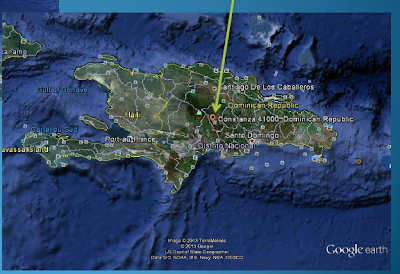
Dr. Thomas Evans recently presented a case study on integrated pest and disease management at the 69th Annual Meeting of the Potomac Division of the American Phytopathological Society held in Shepherdstown, West Virginia.  The findings presented by Dr. Evans were based on his team's Farmer to Farmer trips to the Dominican Republic's Constanza valley. Dr. Evans is a professor of plant pathology at the University of Delaware and his teammate Dr. Keil is a professor of Enthomology at the Catholic University of Ecuador, South America.  They have worked together on eight volunteer assignments in the Dominican Republic since 2008.  A final F2F assignment is planned for May 2013 where part of their agenda includes a Tomato Spotted Wilt Tospovirus (TSWV)/ Thrips Summit meeting with key packers and growers in the Constanza Valley. The findings presented in West Virginia will serve as a framework for the planned Summit meeting. Google Earth Map identifying the location of the ...

Information and Communication Technology in Agricultural Development

Image
Information and communication technologies (ICT) can play an important role in agricultural development, particularly in helping address the need for technical training, knowledge about markets, advertising, and more. ICT can help improve the livelihoods of farmers as well as the overall efficiency of agricultural sectors in developing countries. Partners has increased the use of ICT tools in the Farmer to Farmer (F2F) program and is seeing results. Videos, for example, have been developed to help promote the products or work of host organizations, or serve as agricultural training tools. Information management specialists have helped universities develop library and catalog systems to better train students. And F2F currently has someone using a geographic information system (GIS) to map country projects against sub-regional data on stats like malnutrition to see how the program relates to poverty levels. As video has been a popular tool, below are so...

Aspiring Mushroom Producers See the Fruits of Their Labor!

Image
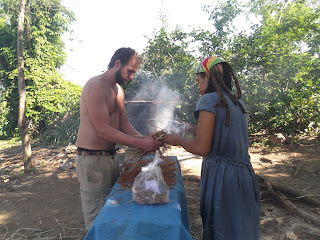
Nick and Agape bagging innoculated sawdust. Agape and Kwao Adams of Yerba Buena Farm in St. Mary, Jamaica, have successfully grown their first mushrooms! Since December 2011, when Agape first requested a visit from a Mushroom Specialist, the Adams have been interested in producing mushrooms as they are one of the only crops that can thrive in the shade of mature fruit trees. Agape reports that most of the land in their area is dominated by fruit orchards; this is great when the trees are in season, however, during the off-season the land is unproductive. In March 2012, the Adams received their first visit from Mushroom Specialist Nick Laskovski of Waitsfield, Vermont. Together, they inoculated various log species with shiitake and oyster mushroom spawn. Unfortunately, the dry season began shortly after Nick’s visit, and the Adams weren’t able to supply the spawn with the amount of water they required. Pests devoured the spawn before the spawn could colonize the logs. ...

Chicken Farmer from Vacaville, CA Shares Experience with Haitian Counterparts

Image
First chicken farm visited upon Alexis' arrival in Haiti A month ago yesterday Alexis Malick-Koefoed, a chicken farmer from California ( Soul Food Farm ), found herself on her way to Haiti to conduct her first Farmer to Farmer assignment. A fellow rancher and repeat Farmer to Farmer volunteer had directed her to the Program. She gathered all the information she could and headed to Haiti to see what she would find, and how she would be able to help the farmers improve their odds of success. Her scope of work included assessing the chicken industry, especially analyzing options and nutrition content of chicken feed and working with women farmers to improve their enterprises. With the assistance of Farmer to Farmer and local technicians, the women are trying to increase their understanding of chicken production as a micro-enterprise, which is new to many of them and holds the potential for them to improve their livelihoods. Students stayed for hours and asked many question...