Posts

Long Time F2F Volunteers Make Local Paper in River Falls, Wisconsin
Image
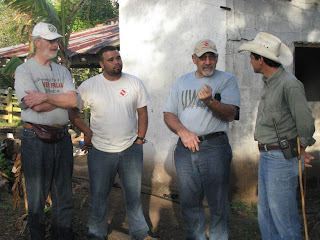
Jerry Nolte & Tony Jilek are veteran F2F volunteers who have worked in Nicaragua for the past few decades, building upon the work and relationships they have developed in the country.  Both are retired University of Wisconsin-River Falls (UWRF) Agriculture professors. Jilek taught at UWRF in the College of Agriculture, Food and Environmental Science (CAFES) for 26 years and Nolte taught for 30. In addition to their continuous support to the Farmer to Farmer program, both Jilek and Nolte are active members of the Partners of the Americas' Wisconsin/ Nicaragua Chapter. Yesterday, December 18th,  the River Falls Journal in Wisconsin wrote an article about their Farmer to Farmer trips and work with Nicaragua/Wisconsin Chapter.  Please check it out: http://www.riverfallsjournal.com/event/article/id/103746/ Nolte & Jilek in the field during their 2011 FTF trip

Update from the Field: Planting Gardens in Haiti

Image
US and Haitian farmers creating a garden with donated seeds This week in Haiti, Farmer to Farmer volunteers and field staff are busy working together with a group of women in Lory to plant gardens, improve their seedling nursery, and advance their chicken production and processing. Lory is a small town in the North of Haiti, about 10 km from Cap Haitian. The women in this community have made the most of the training they have received - beginning with small gardening and later moving on to rabbit production and now chicken production. They have expressed the desire to beautify their town and even explore future options for agri-tourism. Traditionally, Lory is known for the pottery that they hand-craft with the clay from their area. The group in Lory recently received a follow-up visit by Master Gardener Tom Syverud from Wisconsin, focusing on organic production. Continuing with the momentum of this visit, currently in country are three farmers from Vermont - John Hayden, David...

Work Can Be Fun! An Action-Packed Staff Trip to "The Land of Many Waters"

Image
Meghan, Kelvin and Chrissy on their way to visit hydroponic producers in Essequibo. From October 7 - 15, 2012, the F2F field team in Guyana was privileged to be able to host our colleagues from F2F Headquarters (HQ) in Washington, DC. The visitors were Mrs. Meghan Olivier, Deputy Director of the F2F Program and Ms. Chrissy McCurdy, our Program Officer. For a long time, Chrissy had been affiliated with F2F activities in Guyana via e-mails, photographs and second-hand information from her teammates and volunteers, but this was going to be her first visit to the “Land of Many Waters”. Guyana Field Staff wanted to ensure that the visit was both meaningful in terms of HQ staff exposure to as wide a range of activities as possible and, at the same time, experiential in terms of exposure to various local cuisine and sight-seeing. Meghan presenting a hydroponic production sign to producer, Verna D'Aguiar. Because the F2F program has had activities in 6 of Guyana’s 10 admin...

Beans, Beans: They're Good for More than Your Heart!

Image
Distributing seeds. In October, Farmer to Farmer veteran Ira Richards returned from Nicaragua after having successfully carried out a promotional campaign for the use of Mucuna pruriens , better known as the velvet bean. The plant, infamous for its itchiness, is widely used across the world as a forage, fallow and green manure crop, as it fixes nitrogen and fertilizes soil. Mr. Richards followed up with farmers producing the velvet bean as a nutrient supplement for their cattle and soils, providing technical assistance to further optimize the use of the beans in hopes that increased production and usage will result in better cattle nutrition, increased milk production, and more sustainable agriculture in general. Velvet bean vines climbing a tree Working with the dairy cooperative San Felipe de Boaco, Mr. Richards distributed 20 pounds of velvet bean seed for demonstration trials and seed multiplication for each of the 26 farmers who participated in a planned field day at the...

From the Field: A Very Hands-On Investigation of Ecotourism Opportunities in Cimarrones, Baeza, Ecuador

Image
Volunteeer Alan Robinson exploring Cimarrones' biodiversity. Alan Robinson, retired Community-Based Tourism Consultant hailing from Buena Vista, CO, will be wrapping up his 3-week trip to Ecuador in just a few days. Mr. Robinson has been in the Baeza region of Ecuador (2.5 hours SE of Quito) since November 14th, where he and host Noé Pinto of La Corporación Ecológica Cimarrones (Cimarrones Ecological Corporation) have been exploring sustainable and environmentally-friendly ecotourism opportunities for Baeza’s Cimarrones sector. Key objectives of Mr. Robinson’s visit include: completing an evaluation of the potential value of Cimarrones’ natural resources and biodiversity; providing recommendations on how to utilize these resources to initiate an ecotourism project; and connecting with other ecotourism companies in the region to discuss collaboration. Last week, Mr. Robinson provided the following update from the field, describing the activities that he and Noé have carried ...

Discovering Guyana through the lens of a volunteer : Video production specialists Jack and Chelsey

Image
"Guyana is a weird country, you know. But I'm sure you've figured that out by now.." mused the newest guest at the bed and breakfast. In fact, we had. Jack and I met up in Miami, him having come from a hectic five weeks campaigning for the elections and I from 5 months teaching in Patagonia, Chile. It was an appropriate meet-up. As two young travelers, naturally we would be sharing a bacon pizza in Miami before heading out to teach video production in Guyana. We were excited, for the project as well as visiting a country neither one of us had considered visiting prior. Nearly two weeks later, we are both in agreement that this country is unlike any other. From the parade of rescued dogs that meet us every time we unlock both security gates to get to our house, to a different style of chicken and rice being served at every corner, we have ceased to be surprised. Men with dreadlocks drive horse-drawn carts, competing with traffic and taxis. Lotus flowers are ...

Books Need Care and Feeding Too!

Image
The libraries in the Dominican Republic face serious challenges when it comes to book stacks and storage. Library materials require stable environmental conditions. Spikes in humidity and heat are unkind to books. The library at the Universidad ISA faces such challenges. The library windows are open with no glass panes or screens. There are some wooden blinds that are often closed to keep out the sun. While this helps keep the students and library staff comfortable, the books in the stacks suffer from the heat and humidity. Since the library is not air conditioned some ceiling fans keep the air moving. Because the windows are open, pests such as termites, polillas, and moths have direct access to the stacks. They enjoy a diet of glue from the bindings and paper from the textblock. Mold and mildew thrive in tropical climates and the books in the Biblioteca ISA are not immune to this. We found evidence of mold and mildew in many books in the stacks. Other effects of high humidity ar...

Biochar Yields Exciting Results in Haiti

Image
This photo, received from F2F Volunteer and Carbon Roots International co-founder Ryan Delaney, shows the power of biochar for soil fertility in Haiti In August, Carbon Roots International co-director and founder Ryan Delaney traveled to the North of Haiti to team up with Partners of the Americas' Farmer to Farmer Program and conduct trials and trainings on biochar. Biochar is agricultural waste which is transformed into a potent soil amendment; it sequesters carbon and can be made into charcoal to be used for cooking fuel. To read more about biochar visit CRI's website . While in Haiti this month, Ryan and Farmer to Farmer staff checked on the trials and trainees they had previously visited and were impressed with the results. Perhaps most astounding was the change that occurred at Matelot Placid's farm in Acul du Nord, pictured above. While in Acul du Nord in August, Ryan had trained 30 men and women in making biochar and left instructions ...

A "Participatory Approach" to Strengthening Community-Level Natural Disaster Mitigation

Image
From October 5th - 28th, Maryland resident Maixent "Izzy" Ralaingita provided training in Natural Disaster Risk Mitigation to residents of 3 communities in El Salvador. Mr. Ralaingita, an Emergency and Disaster Management professional, was requested by Salvadorean non-profit PROBUSQUEDA to work with these 3 communities to build their capacity to live safely with natural hazards and deal effectively with natural disasters. Community members listen attentively as Mr. Ralaingita reviews disaster mitigation concepts.  PROBUSQUEDA , which advocates for victims of El Salvador's civil war and provides food security programs for victims and their families, recognized the need for community Natural Disaster Mitigation training when heavy rains in the Fall of 2011 flooded homes and destroyed crops. Community members found themselves inadequately prepared for such an event and unable to effectively and efficiently respond. Thinking about the future and strongly considering...

From the Field: Animal welfare in Haiti

Image
The following blog post comes from Robert Spencer, Alabama Cooperative Extension personnel and repeat Farmer to Farmer volunteer, who writes about his past week in Haiti: Robert and producer in La Coline inspect teeth to determine age of buck The first five years of my visits to Haiti have primarily focused on meat quality and food safety as it relates to rabbit production and processing; much of is based on HACCP guidelines. During the past year (year 6) I have added production quality, or as I call it “Animal Welfare”, to my subject matter. This topic was the result of my realization that producers lacked a basic understanding of production essentials in regards to caring for their animals. Based on my observations, I decided to focus on specific areas including nutrition (vegetation, feed, and water), care of newborn, shade and protection from harsh environmental conditions, sanitation, and more. I felt this area was more important knowing that without quality production, ...